
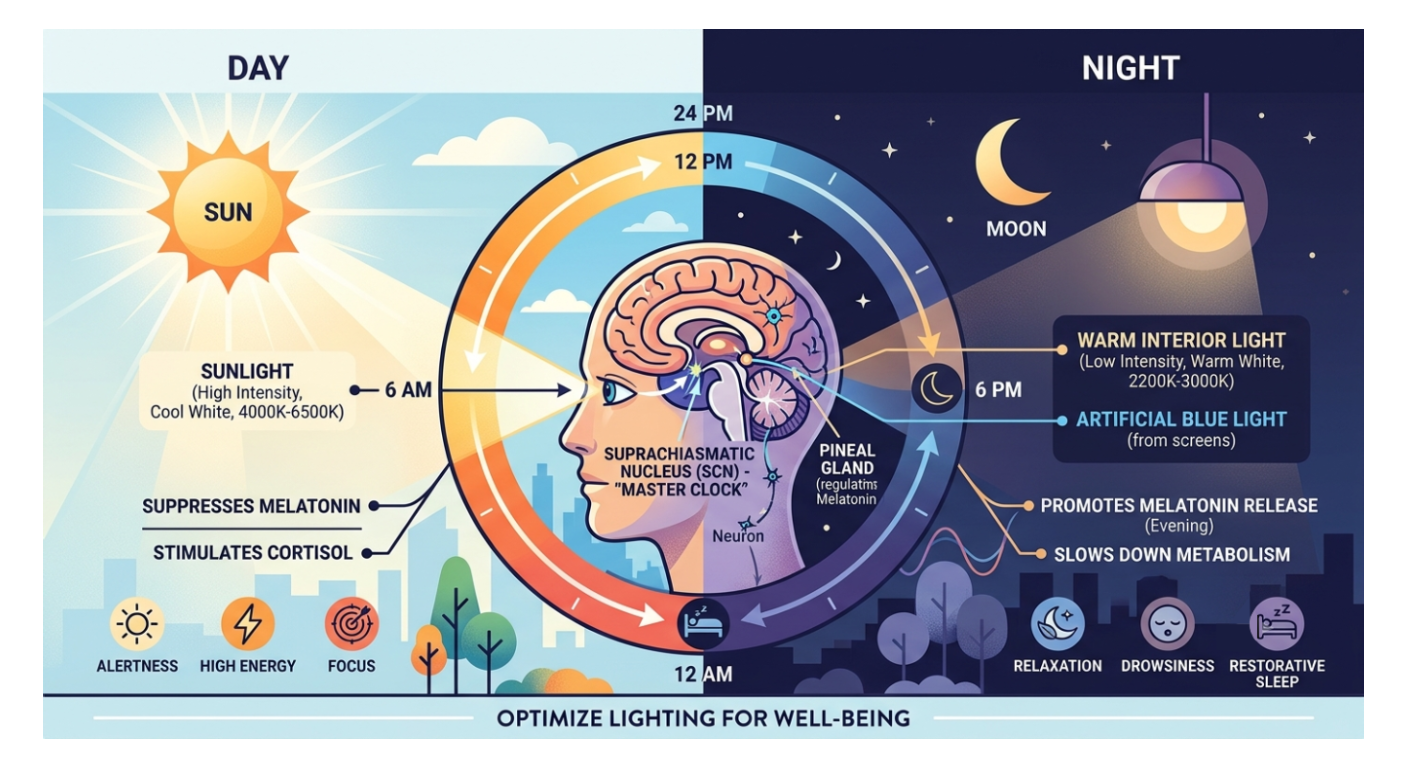
Harnessing the Light Within: How Interior Lighting Shapes Your Circadian Rhythm
We spend nearly 90% of our lives indoors, surrounding ourselves with synthetic light sources that illuminate our desks, kitchen counters, and bedside tables. But light does far more than help us navigate a room—it serves as the master conductor of our internal body clock.
When interior lighting is designed thoughtfully, it aligns with our natural biological rhythms to boost energy, enhance focus, and restore deep, sleep. When neglected, it can quietly disrupt our sleep patterns, mood, and overall health.
Understanding the Master Clock: What is Circadian Rhythm?
Our circadian rhythm is a natural, 24-hour internal clock managed by a tiny region in the brain called the Suprachiasmatic Nucleus (SCN). The SCN relies on environmental signals—primarily natural daylight—to regulate vital bodily functions:
Specialized cells in our eyes called intrinsically photosensitive Retinal Ganglion Cells (ipRGCs) act as sensors. They are particularly sensitive to blue-wavelength light, signaling to the brain whether it is time to perform or time to rest.
How Interior Lighting Influences Our Biology
Modern indoor lighting often disrupts natural cycles because it stays static while our biological needs shift throughout the day. Key lighting qualities shape our biological responses in specific ways:
1. Spectrum & Color Temperature (Kelvin)
2. Intensity & Photometric Lux
3. Direction & Placement
Because ipRGC sensors are located primarily in the lower part of the retina, light coming from above eye level (overhead ambient fixtures, skylights) triggers high alertness. Downward, indirect, or low-level lighting (table lamps, floor washers, wall sconces) creates a calmer, less stimulating environment.
Designing Human-Centric Lighting for Everyday Spaces
Implementing circadian-aligned lighting (often called Human-Centric Lighting or HCL) does not require overhauling an entire space. Strategic adjustments can make a significant impact:
| Time of Day | Recommended Lighting | Ideal Application |
|---|---|---|
| Morning (6:00 AM – 10:00 AM) | High-intensity, cool white light (4000K–5000K) | Open blinds for natural daylight; turn on bright overhead task lights. |
| Afternoon (10:00 AM – 4:00 PM) | Neutral to cool daylight (3500K–4000K) | Maintain clear task illumination to sustain focus and prevent sluggishness. |
| Evening (4:00 PM – 8:00 PM) | Warm white light (2700K–3000K), moderate brightness | Transition to indirect lighting, floor lamps, or dimmed accent fixtures. |
| Night (8:00 PM Onward) | Ultra-warm light (2000K–2400K), low intensity | Use low-level ambient lamps; eliminate direct overhead light and blue screens. |
Key Takeaways for Healthier Spaces
By treating interior lighting as a core wellness element rather than a purely visual accessory, spaces can be crafted to look beautiful while supporting healthier, more balanced lives.
Here is a breakdown of optimal CCT targets across various environments to support biological rhythms while maintaining visual comfort.
| Environment | Optimal CCT Range | Circadian Objective |
|---|---|---|
| Bedroom | 2200K – 2700K | Suppress blue light; promote evening melatonin release |
| Living Room | 2700K – 3000K | Provide warm ambient relaxation after dusk |
| Kitchen / Bath | 3000K – 4000K | Morning task lighting to signal daytime start |
| Office Desk Area | 4000K – 5000K | High circadian stimulus; suppress fatigue and boost focus |
| Restaurant Dining | 2200K – 2700K | Low alertness trigger; enhance cozy social atmosphere |
| Street & Residential | 2700K – 3000K | Prevent nighttime skyglow and residential sleep disruption |
What is CCT : lazurelighting.com/articles/cct-correlated-color-temperature